Hayley Williams: The Blueprint for What It Means to Be Punk Today
Written by Celyse Ramirez May 25, 2026
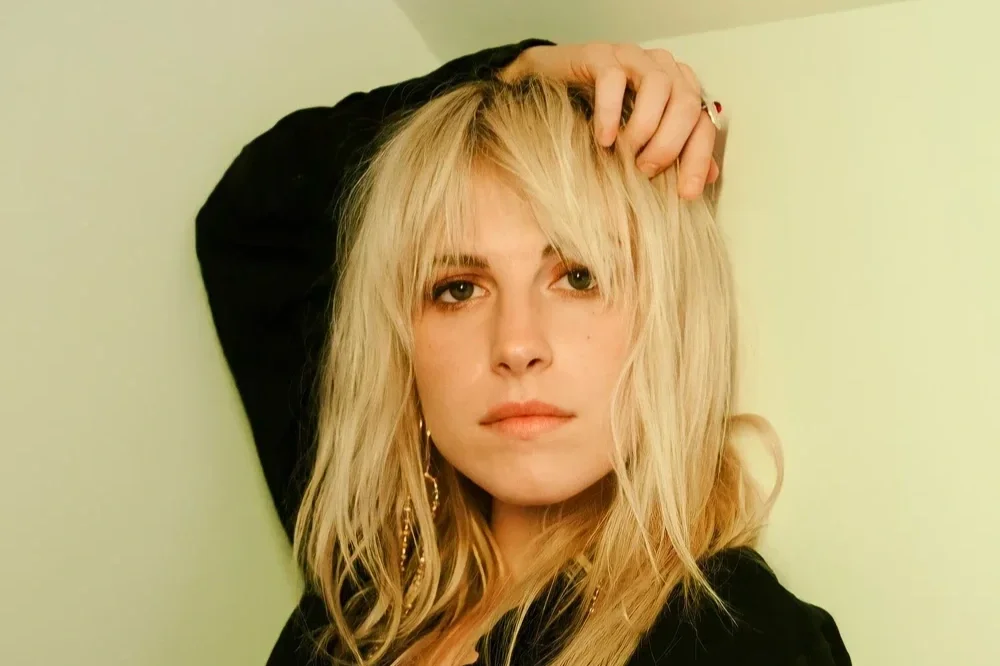
Even through the “testosterone music,” Hayley Williams has transcended what it means to be a woman in music. Creating a lasting impact since she debuted at 14, she has never shied away from having a unique identity, sharing her deepest emotions, and holding her own in a male-dominated world. Now, at 37, she is really carving an identity outside of Paramore, showing that you can constantly evolve 20+ years into a legendary career. Supporting fellow female frontwomen, experimenting with writing and sound, and making her activism the center of her platform is what makes Hayley (Ms. Williams if ya nasty) the most relevant example of what it means to be punk today.
I could talk about Hayley Williams forever. Depending on who you ask, the name could mean everything to the person, or “oh, is that the Paramore girl?” Many aren’t aware of the extent her impact has had on alternative music, women in music, fashion, and even the hair industry. And while the country “bros” on Broadway will discount her career, she has cemented herself into the Nashville Mount Rushmore whether they like it or not!
Pioneering the Early Scene
Coming up in the Warped Tour days in the early 2000s, Paramore was slingshot to success and gave young scene girls someone to look up to, but it came at a cost to Hayley, just a kid at the time. She talks about how it was very much a “you have to keep your head down” mentality: “I was too busy proving myself.” In a 2020 interview with NPR, she reflected on the misogyny bred within the scene on the Warped Tour, one instance being when:
“...I was wearing a square-neck top on stage and all of the sudden something hit me on the chest,” she says. “I’m really sweaty because it’s hot, and I look down and there are condoms stuck to me. I went at anyone who threw things at me, yelled at me to take my top off. I gave no fucks...”
In a podcast conversation with The New York Times, she shamelessly name-drops NOFX and Fat Mike for making inappropriate comments about her on stage as a minor. Enduring all of this from the start of her career would change standards and kick down doors for female front women and band members coming behind her. To this day, Hayley is not afraid to call out men who deserve it, famously leading to the “Catch me at Whole Foods, bitch” line directed at Morgan Wallen and telling fellow icon Kathleen Hanna that she would have no problem fighting Josh Farro, a personal favorite diss of mine.
Putting Her Stamp on Alternative Fashion
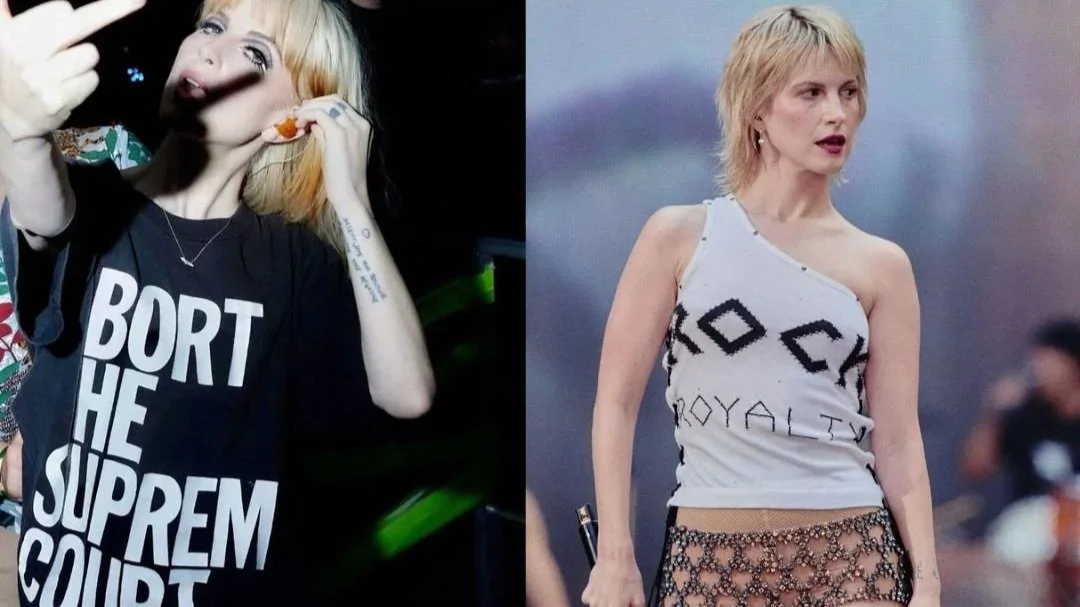
Hayley is truly the cool girl blueprint. Her style has always been bigger than a singular aesthetic or the stereotypical “rocker girl”; it’s her identity, politics, rebellion, and self-reclamation all at once.
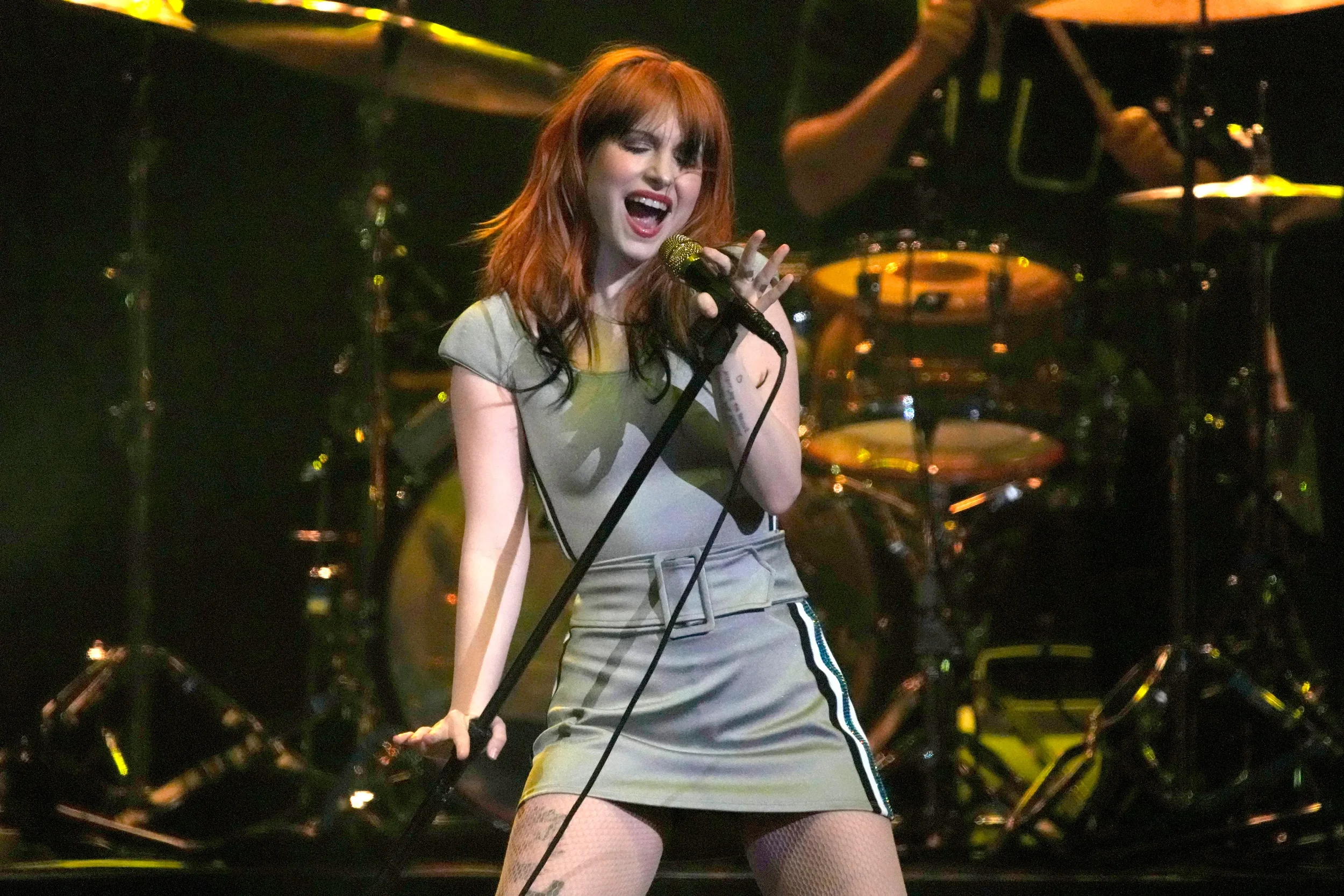
Alongside her best friend, head of glam, and Good Dye Young co-founder Brian O’Connor, Hayley has built an ever-changing visual identity through experimental makeup, dramatic cuts, and chaotic color transformations while somehow remaining unmistakably herself through every era. From coining bright orange hair during the Riot! era to the bleached pixie cut that made her look like full-on rock royalty during the Eras Tour, what is most impressive is seeing that doing whatever she wants to—whether it fits the status quo or not—makes her feel good, and she looks so cool while doing it.
There are honestly too many iconic Hayley looks to count; however, here are a few recent ones to highlight how she uses her stage styling to elevate her message.
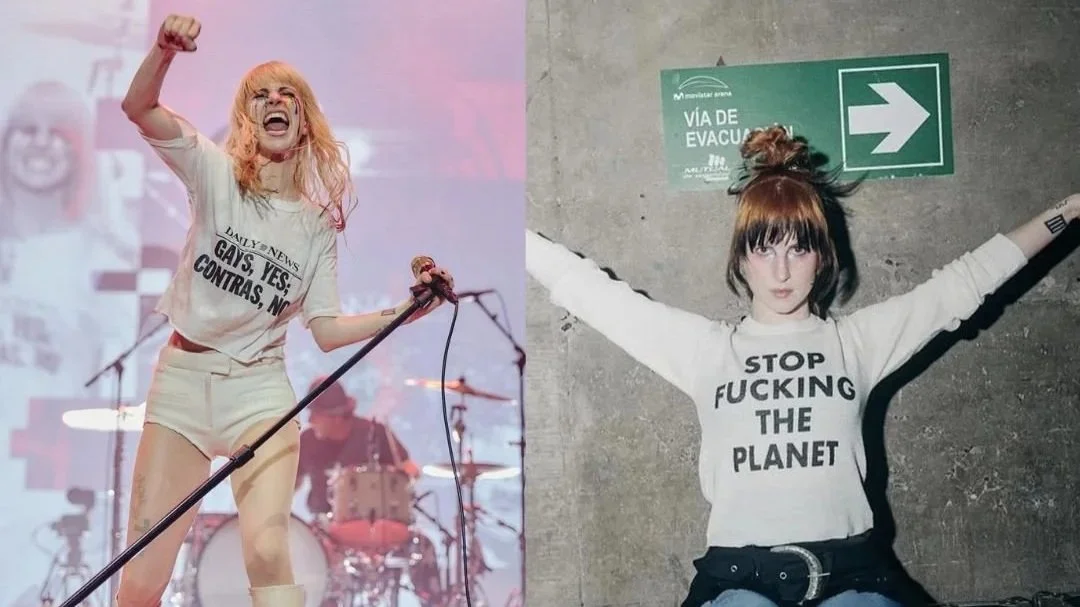
During the This Is Why era, she had an array of graphic tees with bold statements: “Abort the Supreme Court,” “Stop Fucking the Planet,” and the famous “Gays Yes, Contras No” tee at Bonnaroo, referencing the historic 1986 headline. But what makes her style matter is the intention behind it. Punk fashion has always been political and radical, and Williams understands clothing as an extension of resistance rather than just her appearance.
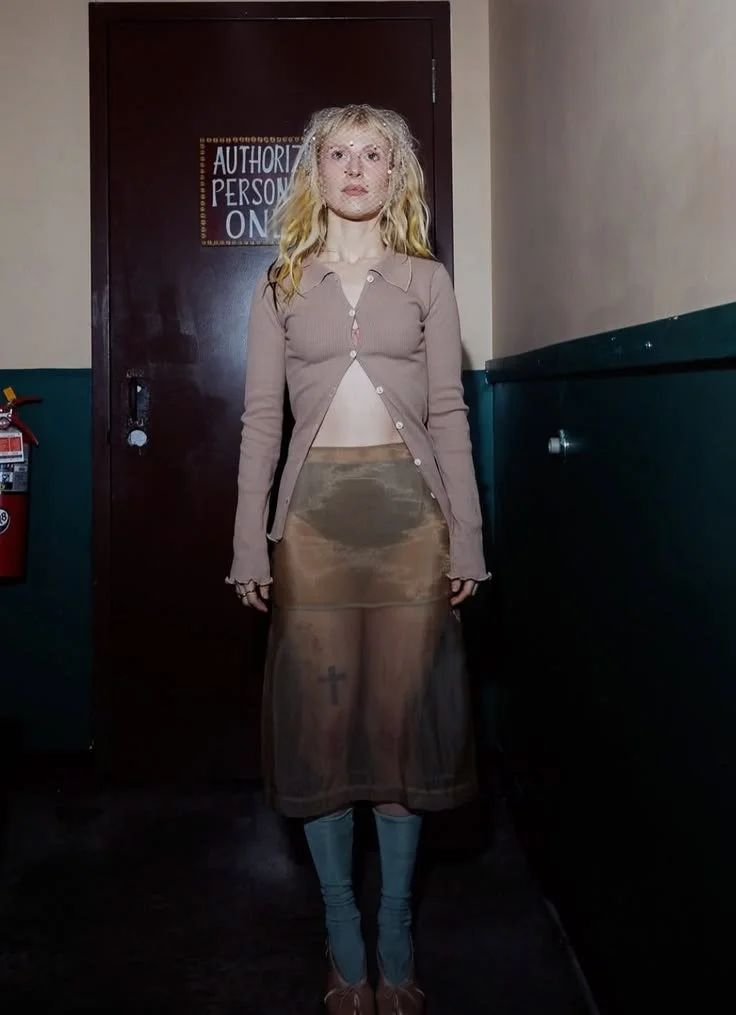
Even now, on the Ego Death at a Bachelorette Party tour especially, her embrace of sheer fabrics, dresses, heels, and hyper-feminine styling feels deeply significant. For years, Hayley has spoken openly about how difficult femininity felt within alternative spaces, admitting on Toby Morse’s podcast that she once viewed her appearance as armor because beauty and femininity felt tied to vulnerability and weakness. Referenced in her song “Hard Times,” she sings about wanting to “kill my feminine,” yet the Hayley Williams of today seems to fully reclaim it. Refusing to suppress femininity became its own act of rebellion.
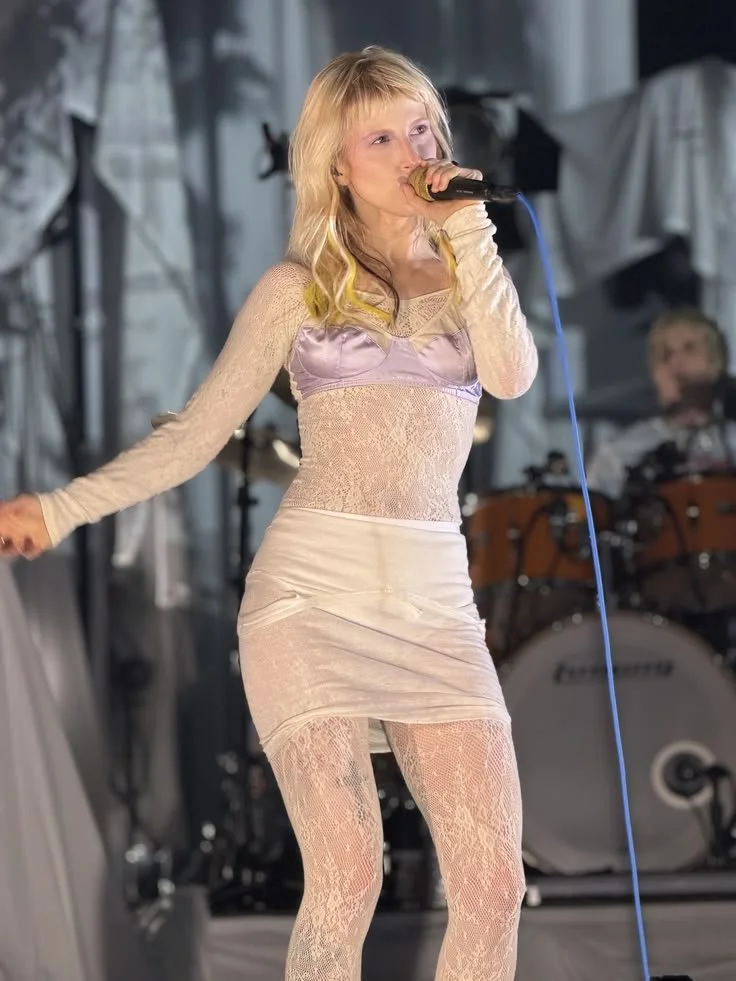
As she explained in conversation with Kathleen Hanna, “hair and fashion are so important to experience for ourselves moving through the world,” and that philosophy is woven through every era of her career. She dresses for expression, not the male gaze, proving femininity can be powerful, confrontational, messy, political, and deeply punk.
Growing up, I remember obsessively stalking Hayley Williams’ StealHerStyle page trying to figure out where every jacket, shoe, or accessory came from because she made self-expression feel limitless. Ten years later, I still obsess over everything she wears. While my stalking has shifted to @hayley.williams.style on Instagram, the sentiment of wanting to look and feel as cool as Hayley Williams is still alive. If being radical and “punk” is about individuality and pushing against restrictive systems, then she has been one of its clearest modern examples all along.
Vulnerability and Powerful Storytelling Through Songwriting
“I love to feel jealous of a song,” Hayley Williams humbly admitted while speaking with Kathleen Hanna, and honestly, that’s exactly the feeling her music leaves behind. There’s something about the way she writes that makes you wish you had found the words first.
Across her career, and especially throughout her solo work, she has mastered the art of turning deeply personal experiences into something painfully universal. Whether unpacking religion, grief, rage, relationships, or the general exhaustion of existing in a burning world, she often frames some of her deepest feelings and personal failures as embarrassing, yet the act of sharing them so openly feels incredibly brave.
In a culture that constantly shames people, especially women, for being “too emotional” or vulnerable, Hayley’s willingness to expose the ugliest parts of herself gives us permission to do the same. Her music creates this unspoken understanding that so many people are carrying the exact same fears, guilt, anger, and sadness, even if they’ve been taught to hide it.
Breaking down a few songs that dive into her vulnerability:
Parachute: Maybe her most earnest yet. Even though the lyrics speak directly to the situation she’s in, I feel the letdown in her voice and in the storytelling.
Asystole: A metaphoric and literal telling of what it means to feel pain both in your heart and head.
Playing God, Liar, Grudges: All examples where the lyrics speak to her bandmates about deeply personal feelings of anger, guilt, and mourning a chapter of life.
Growth and Reinvention: The Queen of Side Quests
Aside from Paramore becoming one of the biggest rock bands of our time, just within the past year Hayley Williams has reached entirely new heights on her own. She launched an independent record label (Post Atlantic), and as a warm-up to kicking off her first solo headlining tour, she dipped into new sounds and genres through collaborations.
A few include Moses Sumney, Jay Som, and even her personal idol David Byrne. At the same time, she’s continued showing up onstage with friends and artists she genuinely admires, bouncing between worlds from H2O and Turnstile to Rico Nasty and Finneas.
That sense of community carries into her own shows too. During the final song of the night, “Parachute,” she returned that same love by inviting both legends and rising artists onstage with her, including Dallas Green, Jason Isbell, Anthony Green, Kat Moss, and KT Thompson, just to name a few. It never feels performative, just like someone genuinely excited to share space with the people inspiring her in real time.
And if you still haven’t heard the debut EP from her new project Power Snatch, made alongside longtime collaborator Daniel James, you’re missing one of the coolest left turns of her career so far. Fans on Bandcamp have described the project as “the coolest new indie post-punk industrial grimy parking lot band.” Power Snatch is the definition of evolution, experimentation, and a super cool side quest.
Watching Hayley bloom into Ms. Williams 2.0 while still chasing the things that make her happiest has been a privilege to witness.
Stage Visuals with a Purpose
The visuals surrounding Hayley Williams’ solo work feel intentionally different from the loud and colorful universe of Paramore. The soft lighting, delicate fabrics, warm colors, lamps, and collected objects transformed the stage into something that felt less like a performance space and more like an intimate living room. There’s a tenderness to it all, like she is creating a safe space sturdy enough to hold the emotional weight of the music itself.
Instead of relying on harsh aesthetics or aggression in the environment, the intensity comes directly from her performance. The rage lives in her voice, her movement, the lyrics—not the set dressing.
My mom, who raised me on Brand New Eyes, took me to Boston N1 of the tour for my birthday, and the contrast was truly powerful and made me feel closer to Hayley than I ever thought I would be.
Even in these softer worlds she creates, Hayley never separates art from politics. At one of her recent solo festival appearances, visuals criticizing Kevin O’Leary appeared on screen as a protest against his presence and involvement with AI developments threatening creative communities and the environment in Utah.
During iHeartRadio ALTer Ego, just weeks before the election, she used a nationally livestreamed stage to directly address the dangers and repercussions surrounding Project 2025 before launching into one of the most powerful performances of “Big Man, Little Dignity” to date, dressed as Debbie Harry like a full-circle punk homage.
She used her first late-night television performance to sing “True Believer”—a song confronting systemic racism in the South—backed by a Black choir while dressed with a nod to Kurt Cobain. That tension between softness and confrontation is what makes her artistry so compelling, especially doing so on national TV.
Hayley understands that punk and radical statements do not lose power when they become vulnerable, thoughtful, or visually beautiful. If anything, it packs a harder punch.
H.W
Credit: Rick Scuteri/Invision/AP
More than twenty years into her career, Hayley Williams still feels radical because she has never allowed herself to become comfortable, predictable, or easy to package. In a culture obsessed with trends and polished celebrity branding, Hayley continues to move entirely on her own terms.
She is a feminist who refuses to shrink herself to make other people comfortable, an activist willing to use every stage she’s given to say something meaningful, and an artist who consistently sets standards instead of following them. Whether she’s calling out misogyny in the scene that raised her, platforming younger artists, experimenting with completely new sounds, or turning vulnerability into something powerful rather than shameful, Williams approaches every part of her artistry with intention and authenticity.
What makes her so important to alternative culture today is that she proves punk is not frozen in time. Through her fashion, politics, songwriting, visuals, and constant reinvention, Hayley Williams has created her own idea of rebellion and has changed what punk and radicalism look like while still honoring its core values of individuality, resistance, and community. She has created space for women, queer fans, and anyone who has ever felt too different or too loud for the worlds around them.
At 37, Hayley Williams is somehow cooler, more fearless, and more creatively restless than ever. Not because she’s trying to stay relevant, but because she genuinely believes in evolving, questioning, feeling deeply, and making art that reflects the world around her.
That sincerity is exactly why people continue connecting to her decades later. Hayley Williams is not just the blueprint for modern punk; she’s proof that staying true to yourself will always be more radical than following the rules.